Significant Data Fiduciary Under DPDP: Obligations, DPO Requirements, Audits and Cross-Border Rules
Being designated a Significant Data Fiduciary adds four obligations no ordinary Data Fiduciary has: a resident DPO, an independent data auditor, annual Data Protection Impact Assessments, and algorithmic due diligence. MeitY has also signalled cross-border restrictions for SDFs. Here is what the designation means and how to prepare.
Short answer: A Significant Data Fiduciary (SDF) is an entity the Central Government notifies as significant based on data volume and sensitivity, risk to Data Principals, risk to electoral democracy, sovereignty, security of the State, and public order. SDFs carry four extra obligations: a Data Protection Officer based in India, an independent data auditor, annual Data Protection Impact Assessments, and due diligence over algorithmic software.
Who Becomes an SDF
The designation is not self-assessed and there is no published turnover threshold. Section 10 of the DPDP Act empowers the Central Government to notify any Data Fiduciary or class of Data Fiduciaries as significant, having regard to:
- the volume and sensitivity of personal data processed,
- the risk to the rights of Data Principals,
- the potential impact on the sovereignty and integrity of India,
- risk to electoral democracy,
- security of the State, and
- public order.
Read plainly, the criteria point at large consumer platforms, financial institutions, telecom operators, healthcare networks, social media intermediaries, and anyone processing data at national scale. The inclusion of electoral democracy and public order signals that reach and influence matter as much as raw record counts.
Key insight: the practical planning question is not "are we an SDF today" but "what would we do if notified next quarter?" Designation is by government notification and can arrive with a compliance window measured in months. The obligations below take longer than that to stand up — an independent auditor cannot be appointed and a first audit completed in six weeks.
The Four Additional Obligations
| Obligation | What it requires | Lead time to stand up |
|---|---|---|
| Data Protection Officer | An individual based in India, representing the SDF, responsible to the board or equivalent governing body. Acts as the grievance-redressal contact point. | 2–4 months (hiring or internal appointment plus authority definition) |
| Independent data auditor | Appointed to carry out data audits and evaluate compliance with the Act. Must be independent of the functions being audited. | 2–3 months (procurement plus scoping) |
| Periodic DPIA | Assessment of the rights of Data Principals, the purposes of processing, and risk management measures — at the prescribed periodicity. | 3–6 months for a first full pass |
| Algorithmic due diligence | Verification that algorithmic software used for hosting, display, uploading, modification, or processing does not pose risk to Data Principals' rights. | Ongoing; needs an inventory first |
The DPO Is Not a Compliance Manager
Two requirements make this role different from an ordinary compliance hire. The DPO must be based in India — a group DPO sitting in Singapore or London does not satisfy the Act for the Indian entity. And the DPO must be responsible to the board of directors or equivalent governing body, which means a reporting line that bypasses the executives whose processing decisions the DPO may need to challenge.
The DPO is also the published contact point for grievance redressal, so the role carries an operational load that scales with your Data Principal count, not with your headcount.
Independent Data Audit
"Independent" is doing the work in that phrase. An auditor who reports to the CTO whose systems are under audit is not independent. The output is an evaluation of compliance with the Act — which means the auditor will need access to your consent records, notice versions, retention logs, breach register, and processor contracts. Organisations that store consent as a boolean flag in a user table discover this the hard way during the first audit.
Data Protection Impact Assessment
A DPIA under the DPDP Act is narrower in scope than the GDPR equivalent but has to be done periodically rather than once. It covers the rights of Data Principals, the purposes of processing, and the measures managing risk. Practically, this is a per-processing-activity review: what data, what purpose, what basis, what safeguards, what could go wrong for the individual.
Algorithmic Due Diligence
This is the obligation with the least precedent and the most ambiguity. The Act requires SDFs to observe due diligence to verify that algorithmic software used for hosting, display, uploading, modification, or processing does not pose a risk to Data Principals' rights. Recommendation systems, ranking algorithms, ad-targeting engines, credit models, and content moderation all sit inside that description.
Nobody has a settled methodology yet. A defensible starting position: an inventory of algorithmic systems, a documented review of what personal data each consumes and what outcomes it produces for individuals, and a record of the fairness or disparity checks you ran. India's AI Governance Guidelines supply useful vocabulary here even though they are voluntary.
Cross-Border Data Transfer
The DPDP Act's default position on international transfer is permissive by the standards of the region: transfer is allowed except to countries the Central Government restricts by notification. There is no adequacy-decision regime and no standard contractual clauses machinery to navigate.
That default is expected to tighten for SDFs specifically. MeitY has signalled an intention to notify cross-border restrictions applying to Significant Data Fiduciaries, alongside its January 2026 proposal to compress the overall compliance timeline from 18 months to 12. For a large platform, the operational consequence of a restriction notification is significant: data localisation for specified categories, changes to where analytics and support tooling run, and renegotiation of processor arrangements with global vendors.
| Ordinary Data Fiduciary | Significant Data Fiduciary | |
|---|---|---|
| Transfer default | Permitted except to notified restricted countries | Same today; additional restrictions signalled |
| Sectoral overlay | RBI, IRDAI, SEBI localisation rules still apply independently | Same, and more likely to be in scope |
| Practical planning | Track notifications | Assume India-resident processing may be required for some categories |
Note that sectoral localisation rules — RBI's payment data directive being the obvious one — apply regardless of DPDP status and are frequently stricter. SDF designation adds a layer; it does not replace what your regulator already requires.
What Goes Into a DPIA
"Conduct a DPIA" is the obligation; nobody tells you what the document contains. A defensible assessment for one processing activity covers eight things:
- Description of the processing — what data, from whom, through which systems, to which recipients.
- Purpose and necessity — why this data is required for this purpose, and what less intrusive alternative was considered and rejected.
- Lawful basis — consent or the specific legitimate use relied on, per data element rather than per system.
- Data Principal rights impact — how access, correction, and erasure are serviced for this activity, and anything that makes them harder.
- Risk identification — what could go wrong for the individual, not for the company. Financial loss, discrimination, reputational harm, physical safety, loss of autonomy.
- Likelihood and severity of each identified risk.
- Mitigations — technical and organisational, mapped to specific risks rather than listed generically.
- Residual risk and sign-off — what remains after mitigation, and who accepted it.
The fifth item is where most assessments go wrong. Teams instinctively write risk registers about business impact — breach costs, regulatory exposure, brand damage. A DPIA is about harm to the Data Principal. If your risk column reads like a board paper, you have written the wrong document.
SDF Status Does Not Replace Your Regulator
A recurring assumption in regulated industries is that DPDP compliance and sectoral compliance are the same programme. They overlap and they are not identical, and where they conflict the stricter obligation governs.
| Area | DPDP position | Typical sectoral overlay |
|---|---|---|
| Data localisation | Transfer permitted except to restricted countries | RBI payment-data directive requires storage in India |
| Retention | Erase when purpose is served | PMLA and regulator directions require multi-year retention of KYC |
| Breach reporting | Report to the Board and affected principals | CERT-In directions impose their own timeline and format |
| Audit | Independent data auditor for SDFs | Regulator-mandated IS audits already in place |
Retention is the classic collision: DPDP says erase, PMLA says keep. The resolution is straightforward once stated — retention required by law is an explicit exception under the Act — but it needs documenting per data class rather than being resolved case by case when a request arrives.
Preparing Before You Are Notified
The four obligations share a common dependency: evidence you can hand to a third party. Most of the preparation is therefore the same work an ordinary Data Fiduciary should be doing for 13 May 2027, done to a higher evidentiary standard.
- Name a DPO-in-waiting and define the board reporting line now, even if the role is part-time until designation.
- Make consent records auditable. An auditor will ask you to reconstruct one person's consent history against notice versions. If that takes a data engineer three days, you have a finding.
- Stand up a processing register — the input to every DPIA you will ever run.
- Inventory algorithmic systems alongside data systems.
- Map data residency — every system holding Indian personal data and the country it runs in. This is the document you need on day one of a restriction notification.
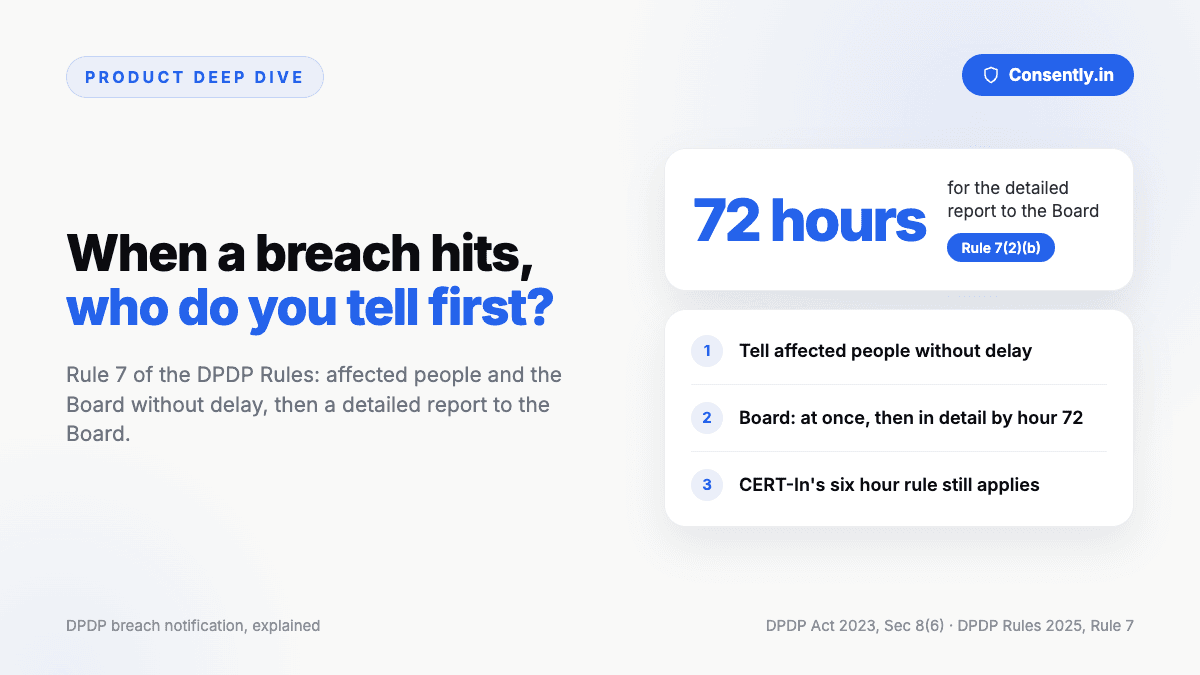
- Rehearse breach notification, because SDF status raises scrutiny of every incident. Our breach notification guide covers the clock.
Frequently Asked Questions
How do I know if my company is a Significant Data Fiduciary?
You do not self-assess. The Central Government notifies a Data Fiduciary or a class of Data Fiduciaries as significant under Section 10, considering data volume and sensitivity, risk to Data Principals' rights, impact on India's sovereignty and integrity, risk to electoral democracy, security of the State, and public order. Large consumer platforms, financial institutions, telecom operators, and healthcare networks are the obvious candidates.
Does a Significant Data Fiduciary need an India-based DPO?
Yes. The Data Protection Officer must be an individual based in India, must represent the SDF, and must be responsible to its board of directors or equivalent governing body. A group DPO located outside India does not satisfy the requirement for the Indian entity.
What is algorithmic due diligence under the DPDP Act?
SDFs must verify that algorithmic software they use for hosting, display, uploading, modification, or processing of personal data does not pose a risk to Data Principals' rights. In practice this covers recommendation engines, ranking systems, ad targeting, credit scoring, and automated moderation. No standard methodology has been prescribed, so an inventory plus documented review and disparity testing is the defensible baseline.
Can Significant Data Fiduciaries transfer data outside India?
Currently yes — the DPDP Act permits transfer except to countries restricted by government notification. However, MeitY has signalled an intention to notify cross-border restrictions specifically for SDFs. Sectoral rules from RBI, IRDAI, and SEBI apply independently of DPDP status and are often stricter.
How often must an SDF conduct a Data Protection Impact Assessment?
Periodically, at the prescribed frequency, rather than once. The DPIA must cover the rights of Data Principals, the purposes of processing, and the measures taken to manage risk. Treat it as a recurring per-processing-activity review rather than a one-off project.
What happens if an SDF fails these additional obligations?
Breach of the additional obligations of a Significant Data Fiduciary carries a penalty of up to ₹150 crore under the DPDP Act's schedule. That sits alongside the ₹250 crore exposure for security-safeguard failures, which applies to every Data Fiduciary.
Where Consently Fits
Every SDF obligation eventually asks the same question: show me the evidence. Consently is built to answer it — immutable zero-PII consent records tied to the exact notice version each Data Principal saw, per-purpose consent history queryable per individual, Data Principal rights workflows with SLA tracking, breach management with the notification clock built in, audit logs designed for external auditors rather than internal dashboards, and India-resident infrastructure with on-premise deployment available for organisations that require it. Talk to us about SDF readiness.